
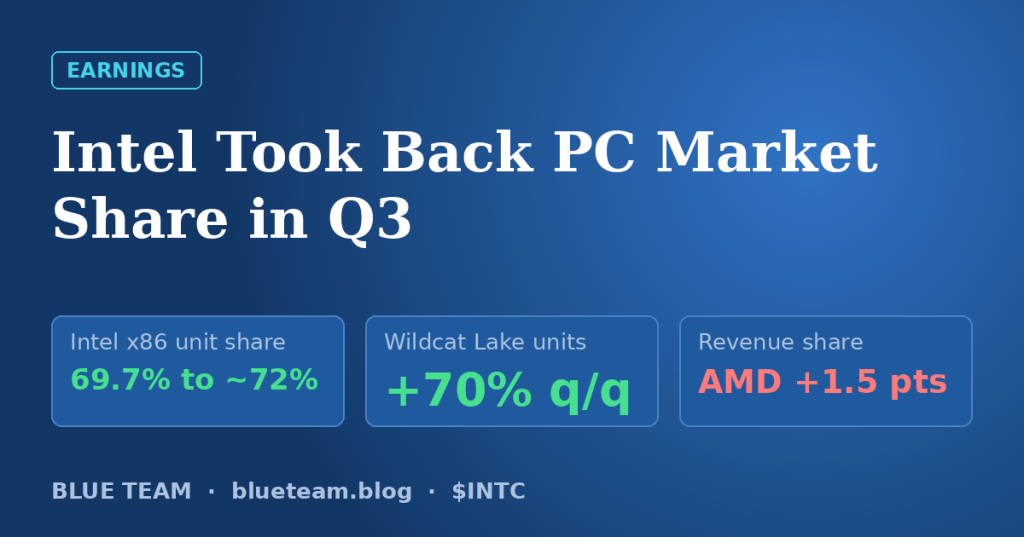
Wildcat Lake lifted Intel’s x86 unit share from 69.7% to about 72%, after a year of losses to AMD. The math, step by step.
Note: the unit figures in this article are Blue Team estimates as of November 3, 2026. We will update it with AMD’s exact client unit growth when AMD files its Form 10-Q.
For a year, the x86 story only went one way. According to Mercury Research, AMD’s share of PC processor units rose from 23.9% in the second quarter of 2025 to 30.3% in the second quarter of 2026. Intel fell to 69.7%.
In the third quarter, that trend broke.
Intel’s PC revenue fell 10.4%, and the market read it as more decline. But revenue is units times price. When we separate the two, using Intel’s and AMD’s own filings and Mercury Research’s unit shares, the numbers show Intel shipped more PC chips than in the second quarter while AMD shipped fewer. Intel’s x86 unit share rose to about 72%.
The driver is Wildcat Lake, Intel’s low-cost 18A processor. Intel says its units grew about 70% in the quarter and that it is sold out.
AMD still held the more valuable end of the market and gained revenue share. That is the full picture, and both halves are below.
Every number is labelled Reported, from company filings or Mercury Research; Derived, calculated from reported numbers; or Assumed, our estimate where nothing is disclosed.
The reported numbers
| PC processor revenue | Q2 2026 | Q3 2026 | Change |
|---|---|---|---|
| Intel, notebook and desktop | $7,700M | $6,900M | −10.4% |
| AMD, Client | $3,062M | $2,949M | −3.7% |
| Year-on-year, reported | Q2 2026 | Q3 2026 |
|---|---|---|
| Intel client units | −8% | −14% |
| Intel client average selling price | +27% | +9% |
| AMD client units | +34% | in AMD’s 10-Q |
| Mercury Research, Q2 2026 x86 client unit share | |
|---|---|
| Intel | 69.7% |
| AMD | 30.3% |
Step 1: Intel shipped more chips than in Q2
Everything rests on one identity:
Equation 1

Revenue  =  Units  x  Average selling price
Intel reports only year-on-year changes, so we chain them through 2025. Intel’s filings give 2025 client revenue of $6.60 billion in Q2 and $7.32 billion in Q3:
Equation 2

U Q3 2026      0.86      7.32
----------  =  ----  x  ----  =  1.037        Intel units  +3.7%
U Q2 2026      0.92      6.60
This assumes Intel’s average price was about the same in Q2 and Q3 of 2025. If it differed by 3% either way, the result moves between +0.7% and +6.9%. In every case, Intel’s shipments rose.
Step 2: from shares to chips
Using Mercury’s 69.7 / 30.3 split, and an estimated x86 PC market of about 62 million chips in Q2:
Equation 3

Intel Q2  =  0.697  x  62M  =  43.2M          AMD Q2  =  0.303  x  62M  =  18.8M
Intel Q3  =  43.2M  x  1.037  =  44.8M
Step 3: Intel’s average price fell 14%, while list prices rose
Equation 4

Intel price Q2  =  $7,700M / 43.2M  =  $178
Intel price Q3  =  $6,900M / 44.8M  =  $154       a fall of about 14%
Intel’s 10-Q says its prices rose year on year mainly because of “pricing actions.” Intel raised list prices. A 14% fall in the average price can only come from selling a much larger share of cheap chips.
Step 4: sizing the cheap-chip wave
Split Intel’s chips into a core tier at average price p_c and an entry tier at p_w. If m is the entry share of units:
Equation 5

P  =  p_c  -  m  x  D          D  =  p_c  -  p_w

      p_c  -  P
m  =  ---------
          D
With a core price of $215 and an entry price of $55, both assumed, and 80% of the price fall coming from mix:
Equation 6

m Q2  =  215 - 178  /  215 - 55  =  0.23        Entry chips Q2  =   9.9M
m Q3  =  210 - 154  /  210 - 55  =  0.36        Entry chips Q3  =  16.2M

Increase  =  about 6.3M entry chips,  +63%
Across core prices of $200 to $230 and market sizes of 55 to 70 million, the increase stays between 5.6M and 7.2M chips.
Step 5: the model meets the earnings call
The model uses no Wildcat Lake data, yet it finds the entry tier grew +63%. Intel’s CFO David Zinsner on the Q3 call: Wildcat Lake “increased units by approximately 70% sequentially and is sold out.” CEO Lip-Bu Tan added that “demand for the Wildcat Lake is outstripping supply.”
Equation 7

0.70  x  Wildcat Q2  =  about 6.3M
Wildcat Q2  =  about 9M          Wildcat Q3  =  about 15M
Two independent routes, filing arithmetic and management’s statement, land within a few points of each other. Wildcat Lake was roughly one in three Intel PC chips shipped in the quarter.
Step 6: AMD shipped fewer chips
AMD’s client revenue was $2,490M in Q2 2025 and $2,750M in Q3 2025. Chaining AMD the same way, with h as AMD’s year-on-year unit growth in Q3:
Equation 8

U AMD Q3      1 + h      2,750
--------  =  -----  x  -----  =  0.824  x  1 + h
U AMD Q2      1.34      2,490
AMD’s Q3 client revenue was up only 7.2% year on year. If its average price was flat, units rose about 7%. If it fell 6%, as in Q2, units rose about 14%. Either way, AMD’s units fell from Q2:
| AMD units vs a year ago | AMD units vs Q2 | AMD Q3 units |
|---|---|---|
| +7% | −11.6% | 16.6M |
| +14% | −6.0% | 17.7M |
| +20% | −1.1% | 18.6M |
Step 7: the result
Equation 9

                   U Intel
Unit share  =  -------------------
               U Intel  +  U AMD

Intel Q3  =  44.8 / 44.8 + 17.7  =  about 71.7%
| Q2 2026 | Q3 2026 | Change | |
|---|---|---|---|
| Intel x86 PC unit share | 69.7%, Mercury | about 72%, range 70.7% to 73.0% | about +2 points |
| Intel PC revenue share | 71.5% | 70.1%, reported | −1.5 points |
Intel gains unit share whenever its units grow faster than AMD’s. That holds unless AMD’s units grew about 26% or more year on year, which would require AMD’s average selling price to have fallen about 15% in a year.
Two markets, two winners
- The low end: Intel. Wildcat Lake flooded entry notebooks, Chromebooks and the new Googlebooks, and Intel’s unit share rose for the first time in a year.
- The high end: AMD. AMD’s average price held up and its revenue fell far less than Intel’s, so it gained about 1.5 points of revenue share.
That is how a company can gain market share while its revenue falls. Intel traded price for volume. Whether that trade pays off depends on what follows.
What it means for Intel
- 18A is now a volume process. About 15 million Wildcat Lake chips in a quarter, sold out, is commercial scale, not a pilot.
- Volume fills fabs. Intel’s gross margin is 44%, but about 60% before depreciation on its fabs. Each extra wafer spreads that fixed cost and lifts margins without a price rise.
- The fight moves upmarket next. Nova Lake on 18A-P targets the desktops and premium notebooks where AMD earns its revenue share. Intel says its design wins are tracking at twice Panther Lake’s.
What the math cannot tell us
- AMD’s exact unit number. It comes in AMD’s 10-Q, and only a fall of about 15% in AMD’s prices would overturn the result.
- Buying ahead of the price increase. Intel raised PC CPU prices about 10% on October 5. Some OEMs likely bought ahead of it in September, which may have lifted Q3 units and will weigh on Q4.
- Channel inventory. Mercury reported that Intel pushed millions of mobile chips into the channel in Q2. Shipments into inventory are not the same as sales to end users.
- Estimates. The 62 million market size and the tier prices are our assumptions. The direction of the result is robust; the exact points are not.
- Arm PCs, from Apple and Qualcomm, sit outside the x86 share.
- Q4 will be harder. Intel guides PC chips down more than 20%. Mercury’s official Q3 data, due in the coming weeks, is the final scorecard.
The verdict
After a year in which AMD’s share of x86 PC chips rose from 23.9% to 30.3%, the third quarter of 2026 is the first sign that it has turned. Intel shipped more PC processors while AMD shipped fewer, and Intel’s unit share rose to about 72%.
AMD kept the revenue lead at the high end. But in units, the measure that fills fabs and decides who sits in the next generation of laptops, Intel took back market share in Q3. The low end turned first. Nova Lake will decide whether the high end follows.
Update note: The figures above are Blue Team estimates based on the data available on November 3, 2026. AMD’s Form 10-Q, expected shortly, will state AMD’s exact client unit growth. When it does, we will update this article with the exact number and the final unit-share result.
Related reading: Intel Q3 2026 earnings · Apple’s Mac beat and Intel’s cautious PC guide · Tick-tock is back · AMD showed its 2029 hand · Our thesis on Intel · Famous Intel quotes
Sources: Intel Form 10-Q for Q2 and Q3 2026; Intel Q3 2026 earnings call, October 29, 2026; AMD Q3 2026 earnings tables and slides, November 3, 2026; AMD Form 10-Q for Q2 2026 and Q3 2025; Mercury Research Q2 2026 x86 unit share, as reported by Hardware Busters. Items marked Assumed and Derived are Blue Team estimates. Not investment advice.


Leave a Reply