
On November 2, Wccftech reported a leak from Kepler_L2 that sketches AMD’s next three years. It is not an official roadmap, but it fits the pattern of AMD’s recent leaks:
- Zen 7 “Grimlock” in 2028, reportedly AMD’s first product on TSMC A14, with panel-level FOPLP packaging and desktop chips first.
- RDNA 5 around 2027 to 2028. Discrete RDNA 5 has reportedly slipped to late 2027 or early 2028 because of the DRAM shortage.
- RDNA 5+ in 2029, an optimized follow-up most likely aimed at Grimlock APUs.
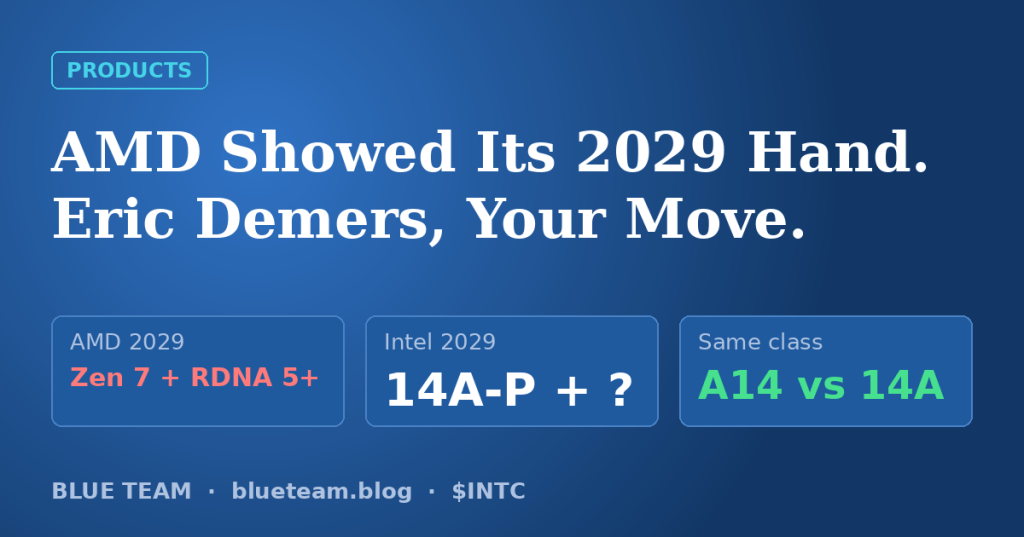
Put together, that is AMD’s 2029 hand: Zen 7 on TSMC A14, launched in 2028 and refined with RDNA 5+ graphics in 2029. Intel’s process roadmap lines up almost exactly. 14A reaches volume in 2028, and if the tick-tock rhythm holds, a refined 14A-P follows in 2029. On the CPU side, Lip-Bu Tan already has an answer. On last week’s call he said of Coral Rapids on 14A: “we’ll be competitive to AMD.” On the graphics side, the answer belongs to one man.
The man Tan had to persuade
In January Intel hired Eric Demers as Chief GPU Architect. Demers spent about a decade at AMD, rising to senior architect, then led Qualcomm’s Adreno graphics for years as senior vice president of engineering. Tan was unusually personal about the hire at the Cisco AI Summit in February: “I just hired the chief GPU architect, and he’s very good. I’m very delighted he joined me, and it takes some persuasion.”
Demers reports into Kevork Kechichian’s data center group. That tells you where the priority is: AI first, gaming second.
What Intel has said, and what it hasn’t
Official:
- In February Intel committed to an “annual predictable GPU cadence”: Xe3P in 2026, then Xe Next.
- The Intel GPU D-Series, formerly Crescent Island, is a Xe3P inference card with 32 Xe cores, up to 480GB of LPDDR5X memory and a 350-watt air-cooled design. Limited shipments are planned by the end of 2026, and on the Q3 call Intel said customer interest is running ahead of its initial expectations.
- Jaguar Shores remains the next-generation AI architecture in Intel’s annual report, with HBM for the high end.
- In client, Panther Lake’s Arc B390 is Intel’s best integrated graphics ever. At CES Intel claimed about 70% higher frame rates than AMD Radeon at similar power and memory. Nova Lake moves to Xe3P with up to 12 Xe cores, desktop included.
Not official:
- Leaks from April say the Xe3P discrete gaming cards were cancelled, that Xe4 “Druid” arrives in 2027 and that another Xe generation follows in 2028.
- Intel has never named the GPU tile for its 2028 and 2029 client chips, or said which fab will build it.
So AMD has a leaked story through 2029: new node, new packaging and new graphics in one product line. Intel has a 2026 story and an outline.
Four questions Demers needs to answer
- What graphics go with 14A, and with 14A-P in 2029? If AMD’s 2029 APUs pair Zen 7 with RDNA 5+, Intel needs a named post-Xe3P architecture with a date. Panther Lake proved Intel can win on integrated graphics. The lead has to survive AMD’s next two moves.
- Will the GPU tile be built by Intel Foundry? Earlier Arc tiles were built at TSMC. A next-generation tile on Intel 14A would be one of the strongest foundry proof points Intel could give: its own most demanding design, on its own node, while AMD moves to A14.
- Is there a discrete gaming roadmap at all? AMD is reportedly delaying discrete RDNA 5 because of memory costs. If both companies retreat, that is a gap, not a reason. A credible Arc plan would stand out precisely because AMD is wobbling.
- What follows the D-Series? Intel promised successive generations on an annual cadence. AMD sells its Instinct line on a yearly rhythm. Intel needs the same visible line: D-Series in 2026, then a named successor with a date.
Where the answer could come
- CES, January 6 to 9: Nova Lake details and possibly the graphics outlook.
- Q4 earnings in late January: whether the D-Series shipped as planned.
- Intel Foundry Direct Connect in the spring: the natural stage to show a GPU tile on 14A.
Tan has rebuilt credibility by saying “as committed” and then delivering. Demers now has the same job in graphics. AMD has shown its hand for 2029. It is Intel’s turn.
Sources: Wccftech, November 2, 2026; Intel Q3 2026 earnings call and release, October 29, 2026; Intel annual report for 2025; Wccftech on Intel’s GPU cadence, February 16, 2026, and roadmap leak, April 25, 2026; Tom’s Hardware on Eric Demers joining Intel; Cisco AI Summit remarks, February 2026. Leaked roadmaps are not confirmed by AMD or Intel. Not investment advice.


Leave a Reply