For two decades Nvidia’s empire has rested on one thing: CUDA, the software that ties developers to its chips. This week at SC26 in Chicago, Intel went after it in the open. It also put its new GPU head to head with an Nvidia card and published the results. Days earlier, Nvidia’s own filing showed it had cut its Intel stake by a quarter. The gloves are off.
Taking Aim at CUDA
Intel’s SC26 message, written by Jeff McVeigh, who runs its data center strategic programs, was direct: “we believe the future of HPC systems is open, heterogeneous and balanced.” In plain words, no lock-in. Intel is pushing one open software stack built on oneAPI, SYCL, Intel MPI, Fortran and the standard AI frameworks.
The proof point came from Veridien, which moved its seismic imaging code from CUDA and HIP to SYCL. Intel says 90 percent of the kernels performed well with no Intel-specific tuning, and a seismic mini-application was ported in under a month. Easy porting is the key that opens CUDA’s lock.
Crescent Island Against Nvidia
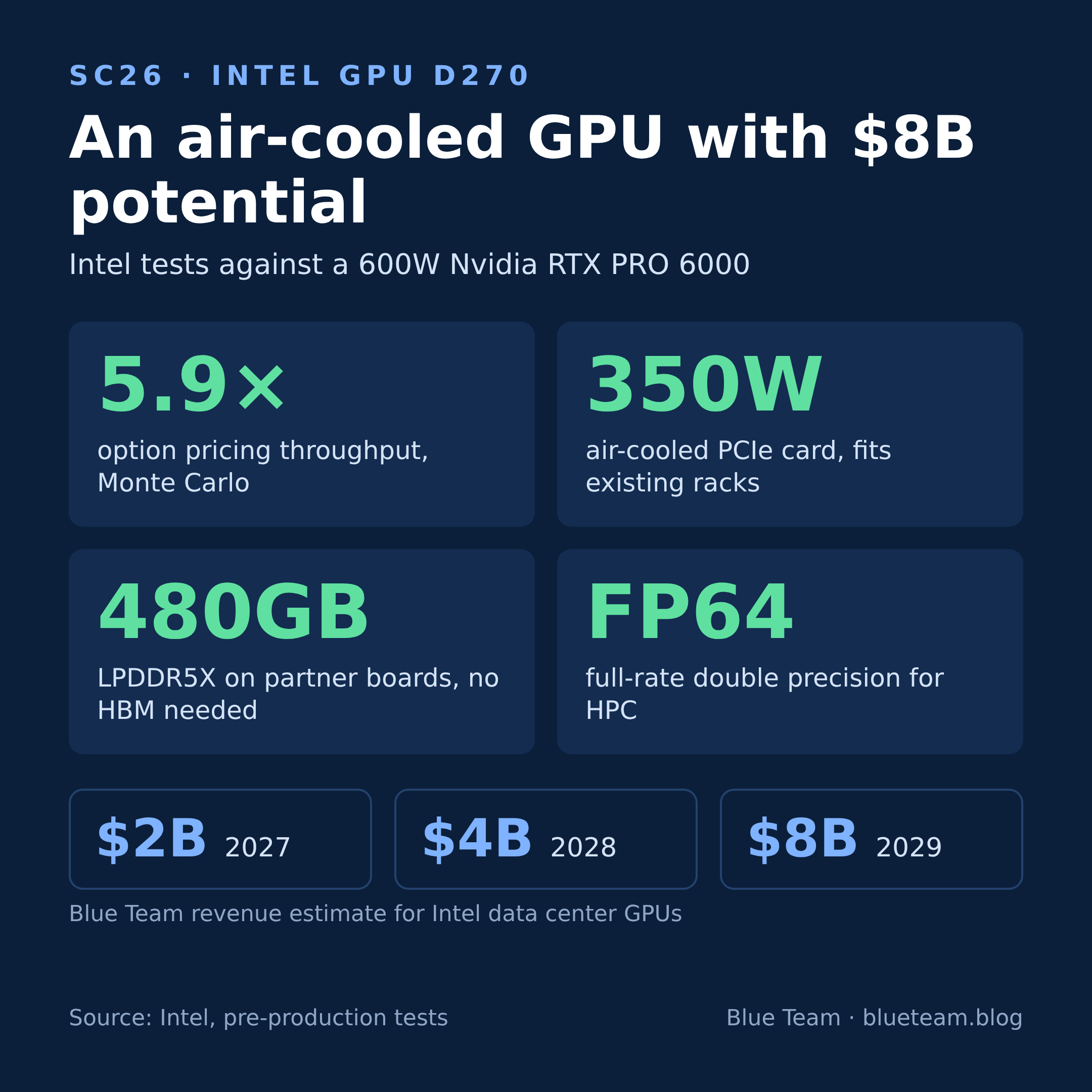
Intel’s GPU D270, the product formerly known as Crescent Island, went straight at Nvidia’s RTX PRO 6000 Blackwell, a 600 watt card. In Intel’s tests on early silicon, the 350 watt D270 delivered:
- Up to 5.9 times the throughput on Monte Carlo option pricing.
- 5.6 times on Black-Scholes and 4.6 times on binomial pricing.
- 1.12 times the throughput on AI inference with a Qwen3 30B model.
- 29 percent lower latency on a decision model.
Behind those numbers is full-rate FP64, the double precision math that science, engineering and finance depend on, and up to 480 GB of memory on an air-cooled PCIe card. SambaNova showed it at SC26 running prompt processing next to its SN50 rack, with Intel Xeon orchestrating the whole system.
We covered the D270 in depth yesterday: Finally, an Intel GPU With $8 Billion in Revenue Potential.
And the CPU to Run It All
Intel also put Diamond Rapids at the center of its HPC pitch: up to 256 performance cores, up to 1.6 TB/s of memory bandwidth, up to 1.28 GB of last-level cache, and built-in AMX matrix engines. Intel calls it the only x86 server CPU with built-in matrix compute for HPC and AI.
Meanwhile, Nvidia Trims Its Intel Stake
Nvidia’s quarterly holdings report, filed on November 16, shows it held 161.1 million Intel shares on September 30, down from 214.8 million at the end of June. That is a 25 percent cut, made before Intel’s October results. Nvidia bought the stake at $23.28 a share in September 2025, so this was profit-taking on a big winner. It trimmed Nokia and Synopsys in the same quarter.
Even after the cut, Intel is worth about $19.4 billion in Nvidia’s portfolio, its second largest holding after SpaceX. But the signal is clear. With a smaller cross-holding and a new leader at Nvidia, Intel has every reason to compete hard.
Game On
The D270 is only the opening move. Intel has described a yearly GPU cadence, with Xe-Next and the rack-scale Jaguar Shores to follow, and it named silicon photonics as the next frontier for linking accelerators, memory and compute. Intel brings what no rival has in one place: its own fabs, its own advanced packaging, the Xeon that runs the rack, and an open software story customers have been asking for. The empire has a challenger.
Sources: Intel newsroom and SC26 statement, November 16, 2026. SambaNova at SC26, November 15, 2026. Nvidia Form 13F for the quarter ended September 30, 2026, filed November 16, 2026. Benchmarks are Intel’s own tests on pre-production silicon.


Leave a Reply