A traditional data center takes more than two years of civil construction before the first server is switched on. By the time it opens, the AI it was designed for is already a generation old. Intel thinks it has the answer, and it says the answer is ready.
Speaking at the ninth China International Import Expo on November 5, Intel China chairman Wang Zhicong said the Green Computing Pod has finished its technical architecture and will have a deployable plan in the first half of 2027.
No building, no wait
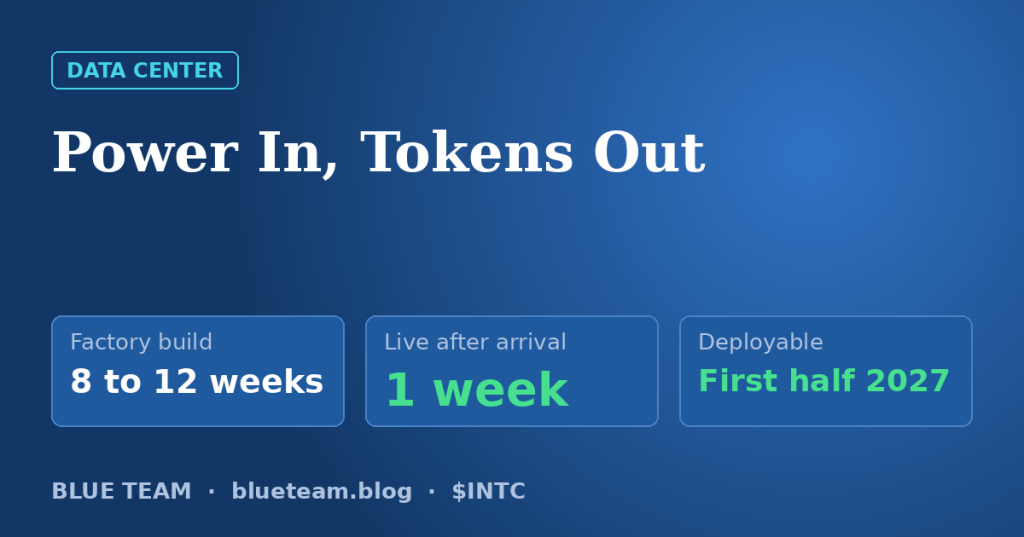
The pod is a standardized container. It needs no physical building, only open ground. The whole unit is customized in a factory in 8 to 12 weeks and can run within as little as one week of arriving on site. When demand grows, more pods are added like stacking blocks. When demand moves, the whole unit can be relocated.
Wang said the team took the design from energy storage and power distribution to compute modules in about three quarters, with dozens of industry partners involved.
Power in, tokens out

The idea starts with a mismatch. Western China has vast solar, hydro and wind resources, but the power is unstable and loses a lot over long transmission lines, while the demand for compute sits in the east. Intel’s answer is to stop moving electricity and start moving tokens. Put the pod next to the power plant, turn green electricity into AI output on the spot, and send the results over the network.
Why inference changes everything
Wang’s bigger point is where AI compute is heading. Two years ago the industry talked about training bigger models. Today it talks about agents, and agents are inference. Over the next five years, he said, a larger share of new compute will land on the inference and edge side.
The driver is privacy. People do not want their personal data in the cloud, and for companies private data is the core competitive asset. The answer is hybrid deployment, with a share of inference compute owned and run privately. That is exactly the ground Intel is built for: Xeon in the rack, Core Ultra in the PC, and security that keeps the data sealed.
His definition of an agent is worth keeping: “Today’s AI agent is essentially a large model plus a harness.” The harness is the constraint layer that makes a model behave, and much of that harness runs on CPUs.
18A is already in the hands of buyers
At the expo Intel showed the full stack for this world: third generation Core Ultra on Intel 18A with RibbonFET and PowerVia, Xeon 6+ for the data center, and an open rack-scale platform specification built for AI agents that need high concurrency and fast sandbox creation. Wang confirmed that 18A chips are already launched in Chinese notebooks, and the next step is pairing them with AI agents.
The bottom line
The pod turns a two-year construction project into a twelve-week factory order. If inference moves to the edge and to private deployments, the winner is whoever can put compute where the power and the data already are, fast. Intel has the chips, the rack specification and now a box to put them in. The first half of 2027 is when it starts shipping.


Leave a Reply