In May 2026, the stock market briefly valued IonQ at 26.9 billion dollars. Rigetti had touched roughly 13 billion the previous October, and D-Wave roughly 10 billion. Three companies, close to 50 billion dollars of combined market value, on about 125 million dollars of combined annual revenue by our estimate from their filings. The mania has since deflated by 60 to 70 percent, but it proved something useful: when investors believe a company holds a winning position in quantum computing, they will pay tens of billions for it years before the revenue exists.
Intel Corporation now holds exactly such a position, and today’s INTC price carries it at zero.
What the specialists say the market is worth
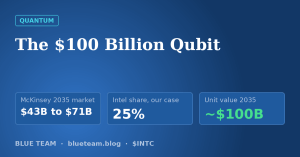
We did not invent the market size. McKinsey’s Quantum Technology Monitor 2026, published in April, projects the quantum computing market at 43 to 71 billion dollars of revenue by 2035, within a 60 to 100 billion dollar market for quantum technology overall, and 1.3 to 2.7 trillion dollars of economic value created. McKinsey raised its own estimate sharply from the prior year. The industry crossed 1 billion dollars of revenue in 2025 and is projected to reach 4.4 billion by 2028, with 12.6 billion dollars invested in 2025 alone. Boston Consulting Group separately projects up to 850 billion dollars of economic value by 2040.
The gate opens around 2029
Today’s quantum computers are noisy research machines. The commercial market arrives with fault tolerance, when errors are corrected faster than they occur. IBM has committed to its fault-tolerant Starling system in 2029, built from roughly 10,000 physical qubits running 200 logical ones, with a larger Blue Jay system targeted for 2033. Google’s long-published roadmap ends at a useful error-corrected machine built from roughly a million physical qubits, and PsiQuantum is engineering toward the same scale. Every serious roadmap converges on the same requirement: fault tolerance needs physical qubits by the hundreds of thousands to millions.
At that scale, quantum computing stops being a physics problem and becomes a manufacturing problem.
Qubits are becoming a wafer problem
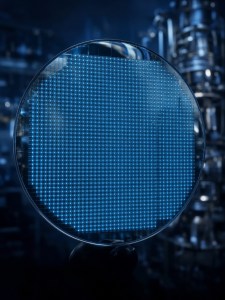
Intel’s qubits are silicon spin qubits, electrons trapped in structures the size of transistors, roughly a million times smaller than superconducting qubits by Intel’s description. They are made in Intel’s Oregon development fab on standard 300mm wafers with the same EUV lithography that prints Panther Lake.
The proof is published. In a May 2024 paper in Nature, Intel reported testing 232 twelve-quantum-dot devices across a full 300mm wafer: 96 percent of devices fully functional, more than 10,000 working gates, and 99.9 percent single-qubit gate fidelity, the highest reported for qubits made with standard CMOS industry manufacturing. The gates were patterned in a single EUV pass, and a purpose-built cryoprober tests whole wafers at one kelvin. The paper’s authors wrote that the results set a new standard for the scale and reliability of spin qubit devices.
Intel’s quantum CTO Pushkar Ranade put the strategy plainly: spin qubits lend themselves very easily to manufacturing on conventional semiconductor equipment. Intel also builds Horse Ridge, its own cryogenic control chip that runs inside the refrigerator, and owns the EMIB and Foveros packaging needed to wire thousands of qubits to their control electronics. IonQ hand-assembles trapped ions. IBM and Google build superconducting chips in specialized lines. Intel is the only company in the race that owns leading-edge fabs.
The full stack is now assembled
In October, Intel agreed to buy Classiq, the Israeli quantum software company, for a reported 2.3 billion dollars. Classiq’s platform turns high-level algorithms into optimized circuits for any quantum machine, with more than four dozen enterprise customers including Comcast, AT&T, BMW, Rolls-Royce and Oak Ridge National Laboratory. Its co-founder Nir Minerbi describes the goal as building the operating system for quantum, and calls silicon spin qubits the most promising modality. Lip-Bu Tan said the deal transforms Intel’s Quantum Computing Group into a full-stack quantum computing business. The close is expected in 2027.
The hardware roadmap now has government backing and dates. In July, Japan’s NEDO selected Hitachi to lead a national silicon quantum program with Intel and the AIST research institute: a cloud service for researchers in fiscal 2027, a roughly 100-qubit prototype running quantum error correction in fiscal 2028, and a roughly 1,000-qubit prototype in fiscal 2030, with Japanese press reporting the chips will be built on Intel’s 18A process. Tan calls quantum a five to ten year strategic direction, sits on the board of PsiQuantum, and has Intel Capital stakes in Quantware and Q-Factor.
The math to 100 billion
Take the specialists’ market and add two assumptions of ours: Intel’s share, and the multiple.
| Scenario | McKinsey 2035 market | Intel share, ours | Revenue | Multiple, ours | Unit value 2035 |
|---|---|---|---|---|---|
| Conservative | $43B | 15% | $6.5B | 6x | ~$40B |
| Base | $57B | 25% | ~$14B | 8x | ~$114B |
| Leader | $71B | 30% | $21B | 10x | ~$213B |
A 25 percent share is the normal take of a category’s full-stack leader, and Intel would be the only vertically integrated player: fab, control silicon, packaging, software and a national program. An 8 times revenue multiple is the sober one for category-leading infrastructure growing more than 40 percent a year. For calibration, the market paid roughly 300 times revenue for IonQ at its May 2026 peak by our calculation. We are assuming the mania never returns and still reaching about 100 billion dollars.
There is a kicker we have not counted: every fault-tolerant quantum computer ships bolted to racks of classical processors for error decoding and control, the same Xeons that run AI agents today.
The checkpoints
This thesis comes with dates a reader can verify: the Classiq close in 2027, the Hitachi and AIST cloud service in fiscal 2027, the 100-qubit error-corrected prototype in fiscal 2028, IBM’s Starling in 2029 proving the fault-tolerant era is real, and the 1,000-qubit prototype in fiscal 2030. Each milestone met moves Intel’s quantum unit from option to asset.
The free option
Ranade is honest that this is not going to be a high-margin business from day one, and today the team numbers about 70 people. But Intel itself just marked the price of one third of the stack: 2.3 billion dollars for the software alone. The fabs, the control chips and the packaging came free with the company. If quantum computing reaches the consultants’ midpoint by 2035 and Intel takes the leader’s share at an ordinary multiple, the unit is worth about 100 billion dollars, roughly 20 dollars per INTC share. The market currently charges you nothing for it.
Three startups with 125 million of revenue were worth 50 billion at the peak. The only quantum company that owns a fab is still priced like it owns none.
Grogu Ledak | The Blue Team
Disclosure: market size figures are McKinsey’s and BCG’s. Intel’s share, the multiples and the 2035 scenarios are our assumptions and require fault tolerance to arrive on roughly the industry’s published timelines. The author may hold positions in the securities discussed. This is not investment advice.
Sources: McKinsey Quantum Technology Monitor 2026 figures · BCG on quantum economic value · The Next Platform on the Classiq deal · Intel’s Nature paper on 300mm spin qubit wafers · The Register on the cryoprober results · The Quantum Insider on the Hitachi, Intel and AIST program · Live Science on IBM Starling · IonQ market cap history · TS2 on Rigetti’s peak


Leave a Reply