
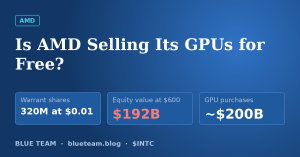
What if AMD’s biggest AI customers are not simply buying its GPUs, but receiving enough AMD stock to recover almost the entire purchase price?
That is the extraordinary economic question raised by AMD’s agreements with Meta and OpenAI.
AMD announces enormous GPU contracts. Investors celebrate the revenue potential. The share price rises. But buried within the economics is an unusual arrangement: AMD is offering its customers the opportunity to become major shareholders at a virtually zero exercise price.
The GPUs are paid for in cash. The customers may recover much of that cash through AMD’s equity. And existing AMD shareholders ultimately bear the dilution.
1. The $100 Billion Meta Deal

Meta’s agreement covers up to 6 gigawatts of AMD Instinct GPU deployments, potentially representing more than $100 billion in purchases over several years.
Alongside the commercial agreement, Meta receives warrants to purchase up to 160 million AMD shares for just $0.01 per share, subject to deployment milestones and share-price conditions. The final tranche requires AMD’s share price to reach $600.
At AMD’s November 4 closing price of $490.83, the potential value is remarkable.
| Economic calculation | AMD at $490.83 | AMD at $600 |
|---|---|---|
| 160M shares, gross value | $78.53B | $96.00B |
| Exercise cost | $1.6M | $1.6M |
| Illustrative GPU purchases | $100B | $100B |
| Equity value / purchases | 78.5% | 96.0% |
| Effective net economic cost | $21.47B | $4.00B |
These figures assume all warrants vest, the shares can be monetized at the indicated prices, and the total GPU purchases amount to $100 billion. They are not a forecast of actual realized returns.
At $600 per share, Meta could theoretically receive $96 billion of equity value against $100 billion of GPU purchases. That is an economic offset of approximately 96%.
Not a conventional discount. Not a rebate printed on an invoice. Something potentially far more consequential: a transfer of equity value from AMD’s shareholders to its customer.
2. OpenAI: The Same Formula, Another 160 Million Shares

AMD has structured a comparable arrangement with OpenAI. Another potential 6 GW deployment. Another warrant covering up to 160 million shares. Another set of commercial and market-price milestones.
Combined, the two agreements could result in 320 million additional AMD shares. At $600 per share, those shares would have a gross market value of approximately $192 billion.
Against an illustrative $200 billion in combined GPU purchases, that represents a staggering 96% economic offset. The arithmetic is simple. The implications are not.
3. How Much Will AMD Be Diluted?

AMD reported 1,630.6 million shares outstanding in its first-quarter 2026 10-Q. Each warrant adds up to 160 million shares at one cent each.
| Warrant | New shares | Added to today’s count | Holder’s stake after issue |
|---|---|---|---|
| OpenAI | 160M | +9.8% | 8.9% |
| Meta | 160M | +9.8% | 8.9% |
| Both | 320M | +19.6% | 16.4% |
If both warrants vest in full, every existing AMD shareholder owns about 16.4% less of the company than before. Meta and OpenAI together would own about one sixth of AMD, received for a combined exercise cost of $3.2 million.
At the November 4 close, those 320 million shares are worth about $157 billion. At the $600 hurdle, about $192 billion. The OpenAI warrant runs to October 2030 and the Meta warrant to February 2031.
4. The Circular Economics of AI
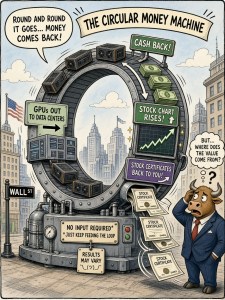
Consider the mechanism.
- Step 1: AMD announces enormous AI infrastructure contracts.
- Step 2: Investors capitalize the expected future revenue into AMD’s share price.
- Step 3: A rising share price increases the potential value of the warrants awarded to those same customers.
- Step 4: Customers can potentially recover a substantial portion of their procurement expenditure through the equity received.
- Step 5: Existing shareholders absorb the dilution if the warrants are exercised.
The customer creates demand. The demand supports the valuation. The valuation increases the customer’s potential equity reward. And the equity reward can dramatically reduce the customer’s effective economic cost.
AMD is not literally giving away GPUs. But under the most favorable warrant-vesting scenario, its shareholders could effectively subsidize almost the entire purchase price.
5. Revenue Is Not the Same as Economic Value Creation
Under US GAAP, consideration payable to a customer, including certain equity instruments, can reduce recognized revenue unless it represents payment for a distinct good or service. The precise accounting depends on the warrant terms, valuation, vesting conditions and applicable guidance.
As of AMD’s first-quarter 2026 10-Q, none of the warrant shares had vested, the warrants were carried as a liability, and AMD reported no revenue impact yet.
That means investors should distinguish among three numbers:
- The headline contractual value of the GPU agreements.
- The revenue AMD will actually recognize after applicable accounting adjustments.
- The ultimate economic cost of the equity transferred to customers.
These are not necessarily the same. And the warrant’s market value today is not automatically the amount AMD must deduct from revenue. A proper assessment requires examining AMD’s financial-statement footnotes and the valuation methodology applied to these instruments.
6. The Intel Comparison
For Intel investors, this raises a fascinating competitive question. When AMD announces $100 billion in potential GPU purchases, how much of that business represents independently profitable demand, and how much is economically supported by the accompanying equity incentives?
Intel’s Xeon and foundry businesses must also be judged on their own commercial economics, including pricing, incentives, margins and capital intensity. They cannot automatically be assumed superior. But the distinction matters.
A dollar of revenue obtained without substantial equity incentives is economically different from a dollar of revenue accompanied by potentially enormous shareholder dilution. If Intel can win comparable business without issuing customer warrants of this magnitude, that could become a meaningful competitive advantage.
7. The Question Wall Street Should Ask
AMD’s strategy could still prove extraordinarily successful. If the contracts generate high margins, expand AMD’s ecosystem, secure long-term market share and create more value than the dilution costs, shareholders could benefit. But that outcome must be demonstrated, not assumed.
The relevant question is no longer simply how many billions of dollars in GPU contracts AMD has signed. It is how much economic value AMD’s existing shareholders will retain after the customers have received their equity incentives.
Because at a $600 share price, the illustrative mathematics becomes difficult to ignore: $200 billion in GPU purchases, $192 billion in potential customer equity value, just $8 billion in illustrative net economic expenditure for the customers.
Those numbers are conditional, not guaranteed, and they do not represent AMD’s accounting profit or loss. Nevertheless, they reveal the scale of the arrangement.
Conclusion: Free GPUs, or Shareholder-Financed GPUs?
Perhaps the most provocative description is not that AMD is selling its GPUs for free. It is that AMD may be using its shareholders’ equity to finance its customers’ purchases of AMD GPUs.
That is a very different business model from an ordinary semiconductor sale. And before celebrating $200 billion in headline contracts, investors should understand precisely who is paying, who is receiving the equity, and who ultimately captures the value.
The GPUs are not free. The real question is whether AMD’s customers are paying for them, or AMD’s shareholders are.
Grogu Ledak | The Blue Team
Disclosure: Scenario analysis based on the stated contractual milestones and assumed purchase values. Full vesting, monetization prices and realized customer benefits are uncertain. This is not investment advice.
Sources: AMD Q1 2026 10-Q · Meta and AMD deal terms · The Stack


Leave a Reply