
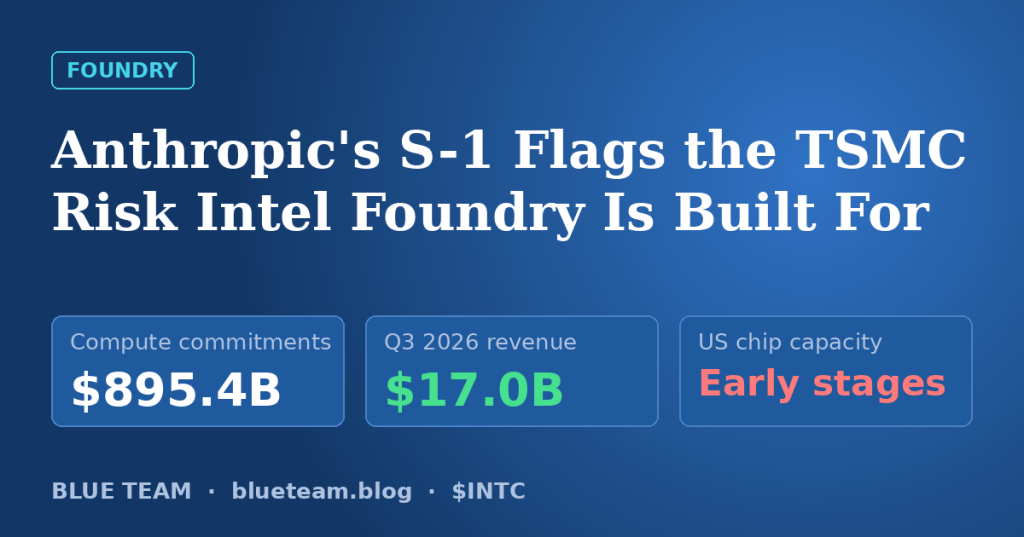
Anthropic filed the first amendment to its IPO registration on November 2. Intel Corporation (NASDAQ: INTC) is not mentioned anywhere in it. But one paragraph in its risk factors describes, almost word for word, the problem Intel Foundry exists to solve.
Key numbers from the filing
- Q3 2026 revenue: $17.0 billion
- Compute and infrastructure commitments: about $895.4 billion, of which $447.5 billion falls before the end of 2030
- Due in the next 12 months: about $69.8 billion
- Named compute platforms: AWS Trainium, Google TPUs, NVIDIA GPUs and AMD GPUs
- Mentions of Intel: none
What Anthropic told the SEC
Under the heading “Supply and Concentration of Chips, Memory, and Data Center Equipment”, Anthropic names Taiwan Semiconductor Manufacturing Company as the place where most of the world’s advanced chip capacity sits, and lists earthquakes, typhoons, power and water outages, trade restrictions and tension between Taiwan and China as risks. Then it says:
“Efforts to establish sufficient advanced chip manufacturing capacity outside of Taiwan, including in the United States, remain in early stages and may not produce adequate compute to materially reduce these concentration risks within the foreseeable future.”
Anthropic, PBC, Amendment No. 1 to Form S-1, November 2, 2026
And on supply already lost:
“Due to the demand for advanced chip manufacturing, TSMC has, at times, been unable to fully satisfy market demand for chip manufacturing capacity, and as a result, we have not always been able to obtain sufficient quantities of chips on a timely basis.”
Anthropic, PBC, Amendment No. 1 to Form S-1
Why this matters for Intel (INTC)
One of the largest buyers of AI compute in the world is telling investors, in a legal document, that relying on one foundry in one place is a business risk, and that it has already been short of chips because of it. That is the demand case for a second leading-edge source in the United States, which is exactly what Intel is building with 18A, 18A-P and 14A in Arizona and Oregon.
Intel’s management sounded the same note on its October 29 call. CEO Lip-Bu Tan said he is “increasingly confident that our Intel 18A-P will be an attractive node for external foundry customers,” and that “we are going to have couple of customer ready to announce in next two quarter.” CFO Dave Zinsner said Intel is “accelerating clean room build-outs, including Fab 62 in Arizona.”
What the filing does not say
We searched the full amended filing, roughly 300,000 words. Intel is not named, and neither are Xeon, x86, CPUs or Intel Foundry. Anthropic buys its compute through Amazon, Google and Microsoft, through Broadcom-built TPU systems and through a SpaceX AI unit running NVIDIA GPUs. Its “early stages” line covers all US capacity, including Intel’s. This is a demand signal for a second source, not an Intel contract.
The test for INTC is the one Tan set himself: named foundry customers within two quarters. Anthropic’s filing shows the buyers want the option. Intel now has to show it can supply it.
Sources: Anthropic, PBC, Amendment No. 1 to Form S-1 (filed November 2, 2026), via Bigdata.com; Intel Q3 2026 earnings call, October 29, 2026. Not investment advice.


Leave a Reply